JUNE 23, 2021
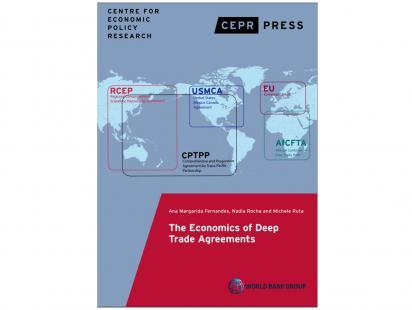
Only in english | In this eBook, Center for Economic and Policy Research (CEPR) and World Bank bring together leading experts in international trade from academia and policy institutions to provide new analysis on the determinants of deep trade agreements. Freely available from 23 June 2021.

Abstract

"While multilateral trade negotiations have stagnated and tensions between major players have surged, bilateral and regional agreements seem to have run away with the trade agenda. There are over 300 agreements today up from 50 in 1990. Most importantly, many of these agreements have extended their reach well beyond tariffs, aiming to achieve integration beyond trade, or “deep” integration.
This CEPR-World Bank eBook brings together leading experts in international trade from academia and policy institutions to provide new analysis on the determinants of deep trade agreements, how they affect trade and non-trade outcomes, and how they might shape trade relations in a post-COVID-19 world."

► More informations and access to the eBook on Vox/CEPR website

Authors

Book coordinators :

  • Ana Fernandes is an economist in the Development Research Group at the World Bank.
  • Nadia Rocha is an economist at the World Bank. Her research  interests include International Economics, Regional Integration, Trade Costs and Trade and Gender.
  • Michele Ruta is an economist in the Macroeconomics, Trade & Investment Global Practice of the World Bank Group

Chapter 11 "Trade barriers in government procurement" authors :

  • Alen Mulabdic  is an economist at the World Bank, his fields of interest include trade and macroeconomics.
  • Lorenzo Rotunno is a researcher at Aix-Marseille School of Economics and focus on market regulations and globalization. 
Latest publications

When economic precarity compounds the harms of homophobia
In many low- and middle-income countries, being LGBTQIA+ entails a double burden: discrimination compounded by economic precarity. Economists Bruno Ventelou and Erik Lamontagne reveal how this combination can undermine mental health, by cross-referencing global data on wellbeing, economic conditions, and the homophobic climate.
In Spain, economic policy has been conducive and has benefited from favourable circumstances
Only in French - An op-ed by Cecilia García Peñalosa (CNRS, EHESS, AMSE) and Alain Trannoy (EHESS, AMSE) published in the newspaper Le Monde.
The True Price of CO₂
In 2024, a grim record was set: it was the hottest year ever recorded on Earth. The signs of climate upheaval are now visible to all, as global warming manifests itself in a rapid rise in extreme weather events. In theory, the solution is straightforward: we must stop burning fossil fuels. In practice, phasing out energy sources so firmly entrenched in contemporary societies is an immense challenge. To reduce CO₂ emissions, economists — trained in cost–benefit analysis — can help policymakers design strategies that are both effective and socially acceptable.