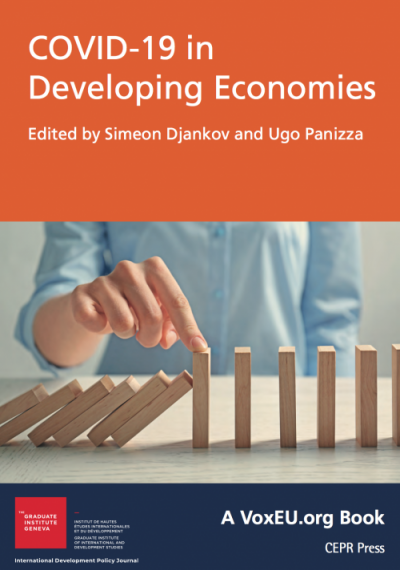
In COVID-19 in Developing Economies, published by the Centre Economic Policy Research, International Development Policy journal and the Graduate Institute in Geneva , co-editors Simeon Djankov and Ugo Panizza note that, whilst there is a large and rapidly growing body of research on the economic effects of COVID-19 in advanced economies, research that focuses on developing and emerging market countries is more limited. The latter face unique health and economic challenges, and differ both in the structure of their economies and the tools available to implement macroeconomic policies aimed at reducing the economic costs of the Covid-19 recession.
"Conflict in times of COVID-19"
Berman and coauthors focus on conflict and, using a counterfactual exercise, find that that the lockdown has reduce conflict intensity in the short-run but that the pandemic may amplify inter-religious and inter-ethnic tension and that violence may explode once mobility restrictions are relaxed.
This chapter discusses the potential impacts of the spread of COVID-19, and the restriction policies that it has triggered in many countries, on conflict incidence worldwide. Based on anecdotal evidence and recent research, we argue that imposing nation-wide shutdown policies diminishes conflict incidence on average, but that this conflict reduction may be short-lived and highly heterogeneous across countries. In particular, conflict does not appear to decline in poor, fractionalised countries. Evidence points to two potential ways in which COVID-related restriction policies may increase conflict: losses in income and magnified ethnic and religious tensions leading to scapegoating of minorities.
More info
→ Check out the publication on CEPR's website