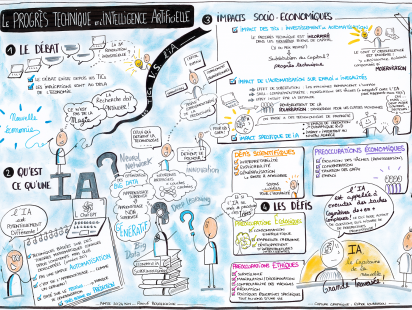
Technical Progress and Artificial Intelligence

Conférences scolaires
Tuesday, November 26 2024| 2:00pm to 4:00pm


Bibliothèque de l'Alcazar
Only in French - “Technical progress and Artificial Intelligence”, an educational lecture by researcher Raouf Boucekkine (AMU/AMSE) as part of the Sciences Echos cycle.
December 05th 2024

Au moment où l'Intelligence Artificielle (IA) est au centre de toutes les questionnements, y compris normatifs, un rappel des grandes leçons de l'histoire des grandes innovations et des révolutions industrielles (avérées et prétendues) depuis le 19ème siècle n'est pas inutile, notamment pour mieux appréhender les implications économiques de court et long terme des paradigmes technologiques émergents.


Raouf Boucekkine est professeur d'économie à Aix-Marseille Université, membre d'Aix-Marseille School of Economics. Il a une longue carrière académique, en France et en Europe, où il a été professeur d’économie dans plusieurs universités et directeur d'institutions de recherche. Raouf Boucekkine s'intéresse à de nombreux sujets, notamment la croissance et le développement.

Tous droits réservés © Aix-Marseille School of Economics / Raouf Boucekkine 

Vidéo bientôt disponible !

Previously issued

  • Dialogues économiques

When economic precarity compounds the harms of homophobia

In many low- and middle-income countries, being LGBTQIA+ entails a double burden: discrimination compounded by economic precarity. Economists Bruno Ventelou and Erik Lamontagne reveal how this combination can undermine mental health, by cross-referencing global data on wellbeing, economic conditions, and the homophobic climate.
January 09th 2026
  • Press

In Spain, economic policy has been conducive and has benefited from favourable circumstances

Only in French - An op-ed by Cecilia García Peñalosa (CNRS, EHESS, AMSE) and Alain Trannoy (EHESS, AMSE) published in the newspaper Le Monde.
December 22nd 2025
  • Dialogues économiques

The True Price of CO₂

In 2024, a grim record was set: it was the hottest year ever recorded on Earth. The signs of climate upheaval are now visible to all, as global warming manifests itself in a rapid rise in extreme weather events. In theory, the solution is straightforward: we must stop burning fossil fuels. In practice, phasing out energy sources so firmly entrenched in contemporary societies is an immense challenge. To reduce CO₂ emissions, economists — trained in cost–benefit analysis — can help policymakers design strategies that are both effective and socially acceptable.
December 10th 2025