

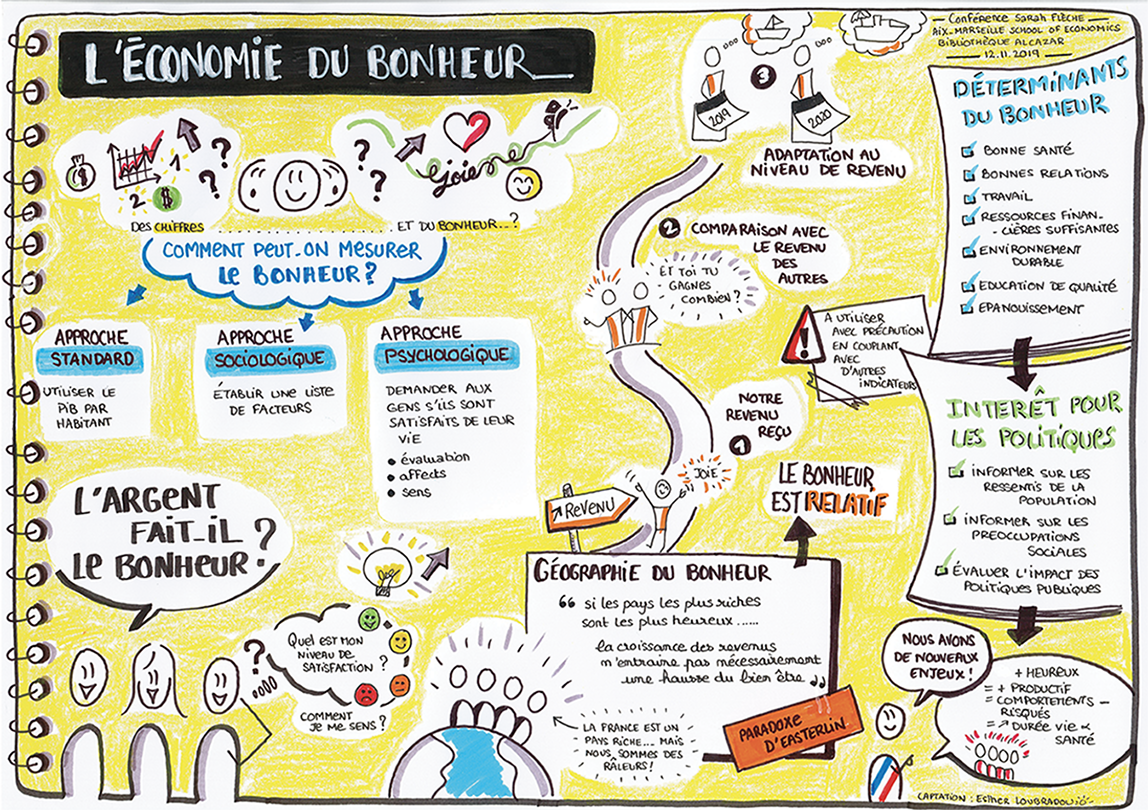
An introduction to research in applied economics and social science that focuses on the economy of happiness.
Sarah Flèche is an applied economist and assistant professor at the Aix Marseille School of Economics (AMSE) since 2017.
Her research lies in the fields of microeconomics, labour, education and behavioural economics and has led to new insights into the measurement of wellbeing and determinants of wellbeing over the life course. In 2018 she co-wrote a book on the Origins of Happiness, published by Princeton University Press. Sarah is also an associate researcher at the Centre for Economic Performance, London School of Economics (LSE). Prior to joining Aix-Marseille University and the LSE, she received her PhD from Paris School of Economics and was a consultant for the OECD.
She held a lecture at Sciences Echos conferences, for a school audience.
The conference focused on measuring people’s wellbeing, the geography of wellbeing, the relationship between income, economic growth and wellbeing, how income inequality and social comparisons can influence wellbeing, and the pros and cons of public interventions designed to improve people’s wellbeing.
Facilitation graphique : Esther Loubradou © Aix-Marseille School of Economics
Slideshows of the lecture (only in French)
More articles
Two articles published in Dialogues Economiques, our online media, about the economy of hapiness and Sarah Flèche's researchs.
> Economy holds the keys to happiness
> Do mothers always bring happiness ?