An online media outlet dedicated to making economics accessible, bridging the gap between academic knowledge and the general public. Dialogues économiques publishes articles, video interviews, and infographics, twice a month, providing information on a wide range of topics addressed by economic research. Available in both French and English, the content may be reproduced in its entirety, provided the authors and the source Dialogues économiques are credited (CC BY-NC-ND). Readers can subscribe to receive each new publication directly in their inbox.


Entrepreneurial motivations impact business performance

Microcredits help microenterprises get started. They are an innovative way to address financial exclusion and unemployment. But business performance is closely linked to entrepreneurial motivation. Renaud Bourlès and Anastasia Cozarenco show that businesses started by « necessity » are less likely to make profits than those that are the result of « opportunity ». So differentiating between entrepreneurial motivations is a challenge for public policies.
JULY 18, 2019
JULY 18, 2019

Whistle-blowing is not just necessary, it’s also measurable

Whistle-blowing has been the subject of far-reaching discussions regarding its justification and its legal support. Although there is a range of laws protecting those who blow the whistle, especially in the G20 countries, whistle-blowers are still at risk. Enhancing their protection seems to be a challenge. Examining the issue, political philosophers Manohar Kumar and Daniele Santoro call for better protection backed up by a set of assessments. They reopen the debate through a three-part series of articles.
JULY 14, 2019
JULY 14, 2019

Of rice and folly in Cambodia: from Angkor to Democratic Kampuchea

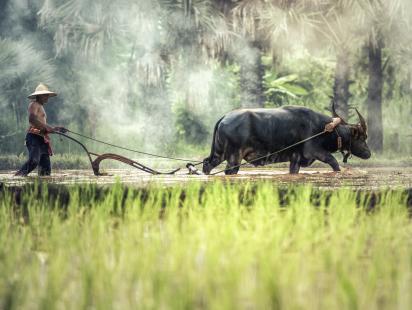
From the Angkor Empire to Democratic Kampuchea, Cambodia has been in turn a land of plenty and of poverty, a prosperous and then battered country. Connecting these two stories, historian Ben Kiernan draws a line: Cambodia has always been a master in the art of rice-growing. Since the glacial era, climatic conditions have shaped a fertile land, home to both the Khmer civilisation and modern Democratic Kampuchea.
JULY 2, 2019
JULY 2, 2019

PORTFOLIO - Between permanency and change: Cambodia and its culture

Econdialog interviewed Ben Kiernan, professor of History at Yale University, about Cambodian history. He explains how its natural resources are a key to understanding the glory of the Angkor Empire. Cambodia was a land of plenty.
JULY 2, 2019
JULY 2, 2019

Addressing inequalities through the social ladder

Going beyond the battle against income inequalities, some look to equal opportunities as a way of offering everyone the same chances and enabling deprived people to escape the poverty trap. Social mobility gives everyone the chance to move upwards. Economists Cowell and Flachaire present a mobility index to add to the existing inequality measures.
JUNE 18, 2019
JUNE 18, 2019

Do mothers always bring happiness?

When is a mother « the mother of all evils »? According to the book « the origin of happiness », written by A. Clark, S. Flèche, R. Layard, N. Powdthavee et G. Ward, a child’s happiness relies on the mother’s mental health. Misery crosses generations and the consequences last into adulthood. To address this issue, the authors call for more attention to mental well-being and recommend preventing depression from an early age.
JUNE 4, 2019
JUNE 4, 2019

Economy holds the keys to happiness

While depression continues to grow in developed countries, a new paradigm is emerging: not wealth-creation, but the creation of well-being. Isn’t that every government’s main goal? Meeting this objective means investigating what determines fulfilment. In “The Origins of Happiness” Andrew Clark, Sarah Fleche, Richard Layard, Nattavudh Powdthavee and George Ward conclude that mental health makes us happier than money.
MAY 7, 2019
MAY 7, 2019

Violence in Africa: multinationals take some of the blame

Multinationals don’t find it easy to trace the origin of minerals produced in conflict-prone areas, but firms are held liable for human and social damage. In a recent scientific article, Nicolas Berman, Mathieu Couttenier, Dominic Rohner and Mathias Thoenig show that the violence induced by variations in mineral prices is associated mainly with foreign-owned firms. For some time now, companies, NGOs and States have been implementing transparency measures. The authors examine their impact on the regions’ stability.
APRIL 25, 2019
APRIL 25, 2019

How the commodity boom encourages violence in Africa

The rise in mineral prices often has bloody consequences for Africa. This was the conclusion of Nicolas Berman, Mathieu Couttenier, Dominic Rohner, and Mathias Thoenig in a recent pan-African survey. The 2000s commodity boom accounted for up to one-fourth of the conflicts across African countries over the 2000-2009 period. Worse still, local battles escalate into regional ones because mines make rebellions financially feasible, spreading conflicts across space and time.
APRIL 23, 2019
APRIL 23, 2019

The "Cold Rush": which countries will save us from climate disaster?

Norway made a historic decision by refusing oil exploration in the Lofoten archipelagos, north of the Arctic circle. It paves the way for preserving the environment for other countries that could be tempted to give in to the Cold Rush. The region is full of oil reserves that have many licking their lips, especially Russia. For the moment, the extreme arctic drilling conditions are a technological challenge that prevents its exploration. By banning arctic drilling as Norway has, other member states of the Arctic Council can save the Arctic sea ice. Their force lies in their unity.
APRIL 9, 2019
APRIL 9, 2019